 © Images de Tunisie — watermarked preview
Photos from the same series
A02-089
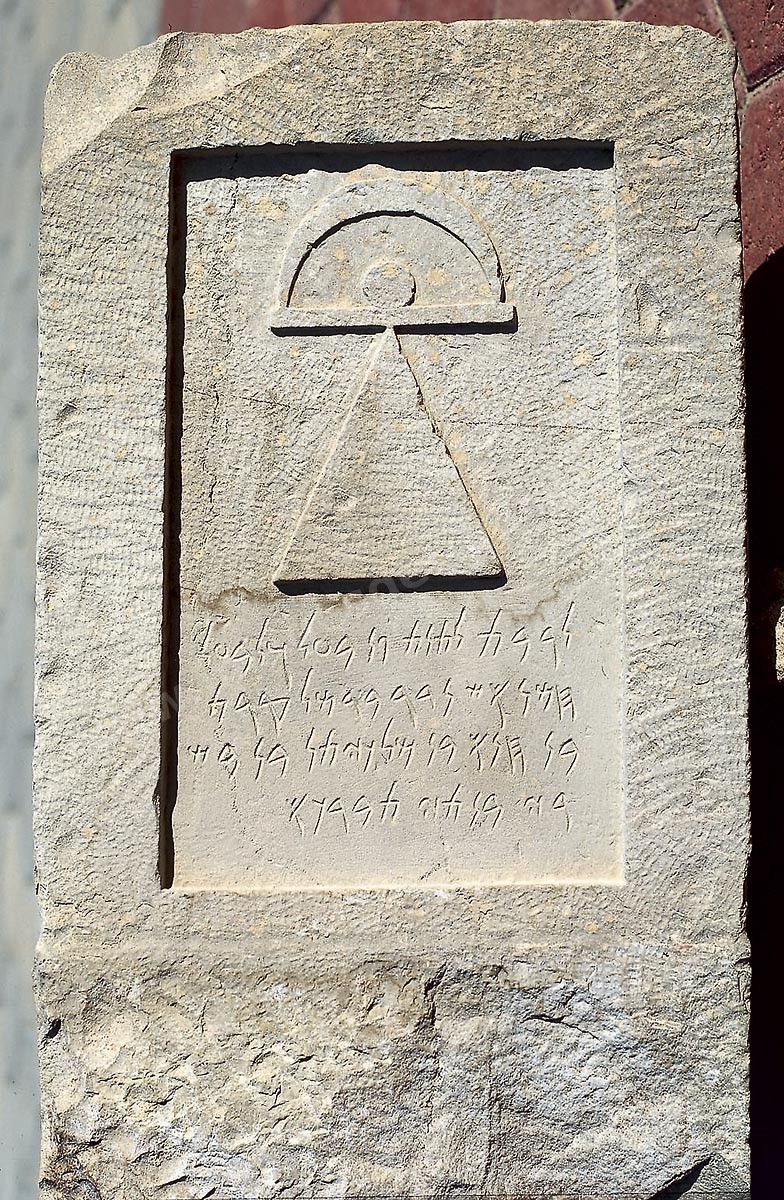
A votive stele made of grayish limestone that stands out from most other steles due to its rectangular shape, its design, the absence of a pediment and acroteria, as well as any other decoration aside from the so-called “Tanit symbol,” which is not incised but carved in bas-relief. While the triangle with a circle resting on its apex is certainly present, the bar above it ends in a semicircle—evoking a crescent—rather than taking on the fairly common anthropomorphic form created by the addition of connected arms. The dedication is in honor of Tanit and her consort, Lord Baal Hammon. This stele confirms the Punic people’s preference for geometric figures and symbolic imagery: the so-called “sign of Tanit” resembles the Egyptian “ankh” and shares its vital significance. Although we possess more than 7,000 stelae (including 1,000 at the Louvre) and more than 6,000 dedications, depictions of Tanit and Baal Hammon in forms other than their symbols are extremely rare (H. 59 cm, W. 33.5 cm, Tophet, Carthage, 4th century BCE, Carthage Museum).
No online payment: licensing is quoted individually based on usage, print run and duration of use.