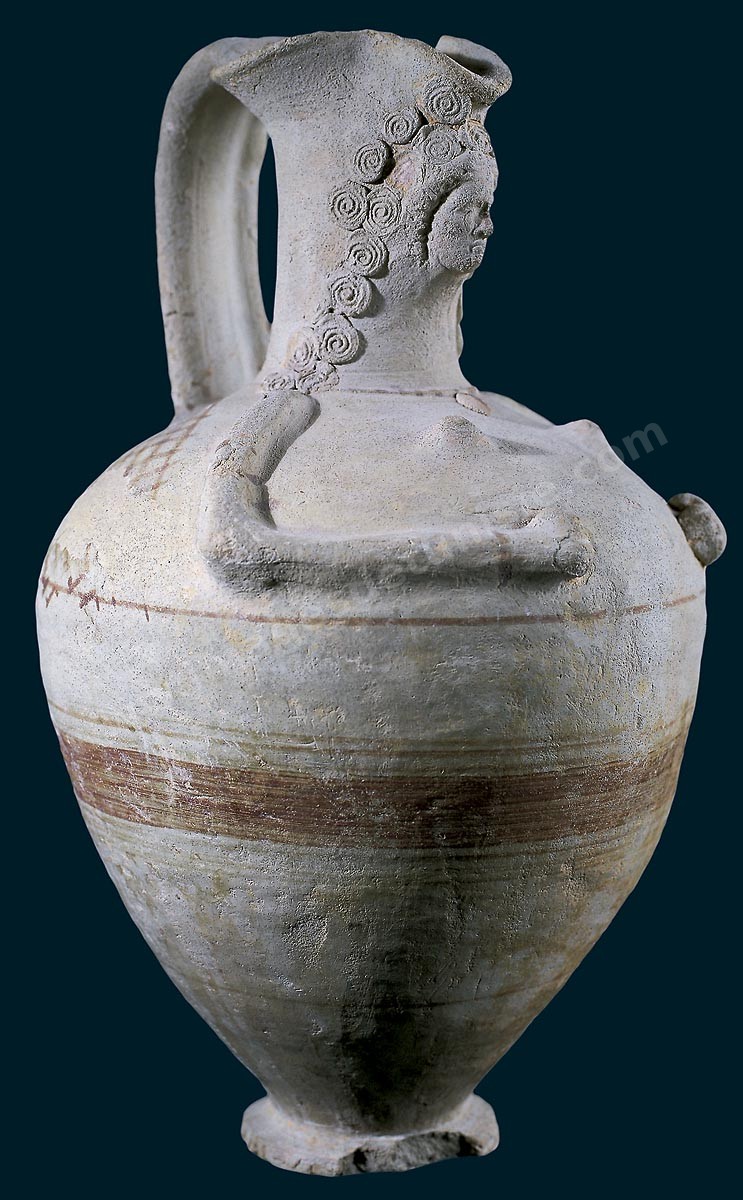
An anthropomorphic oenochoe with a trilobed spout, evoking a pregnant woman. Attached to the neck of the jug, the finely rendered head features a profusion of wavy hair that frames a face with regular features. The neck is adorned with a necklace whose beads are accented with touches of paint. The breasts are depicted on the upper part of the body. The arms, drawn in front, wear dark-colored bracelets. Here one can see the influence of ancient Mesopotamian traditions associated with the theme of the Mother Goddess (H. 31 cm, ø 19 cm, Henchir Beni Nafaa, near Bizerte, 3rd century B.C.E.), Punic section—Bardo Museum© Images de Tunisie — watermarked preview

Photos from the same series

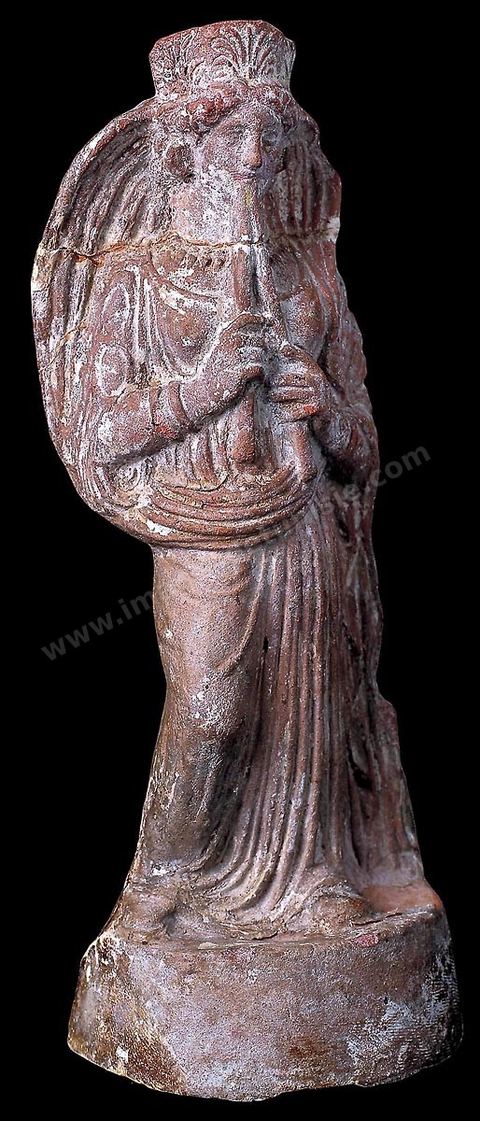
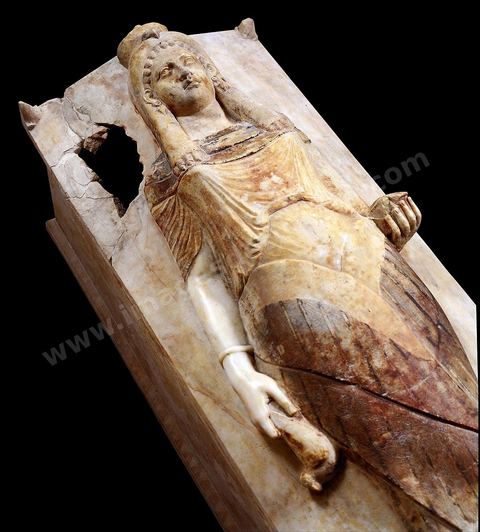
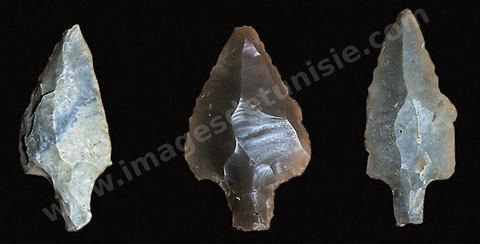
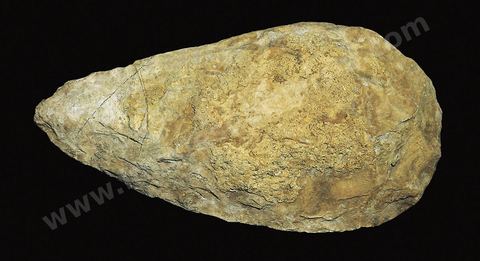
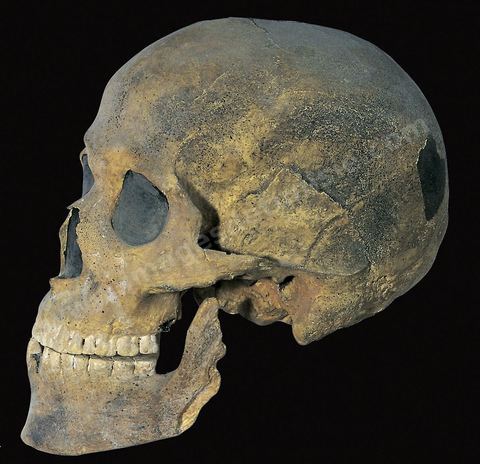
Detail of a Roman mosaic, a medallion depicting spring, part of a floor adorned with laurel garlands and featuring the four seasons (Ras-Boutria - Acholla, the so-called House of the Red Columns, second half of the 2nd century AD, Bardo Museum). Roman section – Bardo MuseumFigurine en terre cuite représentant une femme jouant de la double flûte. Elle porte une tunique longue te un manteau formant voile autour de sa tête, un diadème à palmette et des bijoux (H. 23 cm, nécropole de Borj Jedid, Carthage, IVème siècle avant JC, musée de Carthage).A sarcophagus known as the “Priestess’s Sarcophagus,” made of white marble and decorated with a female figure in high relief. She wears a long pleated robe cinched at the bottom by two large crossed wings. A veil topped with a falcon’s head covers her head in the style of the Klaft. In her right hand she holds a dove, and in her left, an incense burner (H. 93 cm, L. 193 cm, W. 67 cm; Necropolis of Saint Monica, Carthage; 3rd century BCE; Carthage Museum).outils tailles prehistorique, musee du Bardobiface acheuleen, 300000 à 100000 avt JC, musee du BardoCapsian skull, 7000–4500 BC, Bardo Museum
RM

A14-07

An anthropomorphic oenochoe with a trilobed spout, evoking a pregnant woman. Attached to the neck of the jug, the finely rendered head features a profusion of wavy hair that frames a face with regular features. The neck is adorned with a necklace whose beads are accented with touches of paint. The breasts are depicted on the upper part of the body. The arms, drawn in front, wear dark-colored bracelets. Here one can see the influence of ancient Mesopotamian traditions associated with the theme of the Mother Goddess (H. 31 cm, ø 19 cm, Henchir Beni Nafaa, near Bizerte, 3rd century B.C.E.), Punic section—Bardo Museum

ReferenceA14-07
CategoryVilles et Régions / Tunis and its suburbs / Le musée du Bardo
LicenceRM — rights managed
Photographer© Nicolas Fauqué / www.imagesd
Copyright© Nicolas Fauqué / www.imagesdetunisie.com

No online payment: licensing is quoted individually based on usage, print run and duration of use.