Carthage
1–100 of 229 · page 2/5
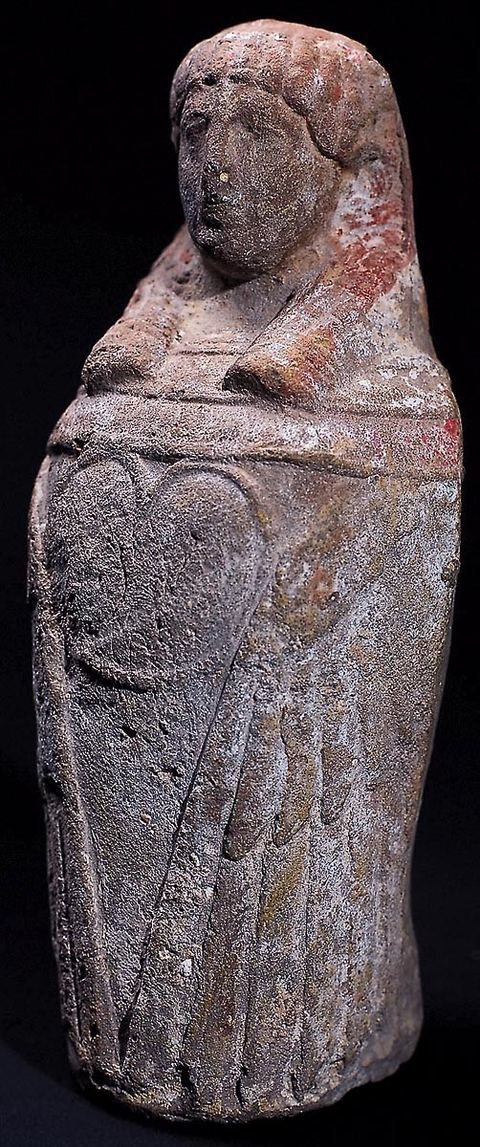
Terracotta statuette in the shape of a canopic jar (H. 15 cm, Borj Jedid necropolis, Carthage, 4th century B.C., Carthage Museum).
A02-058
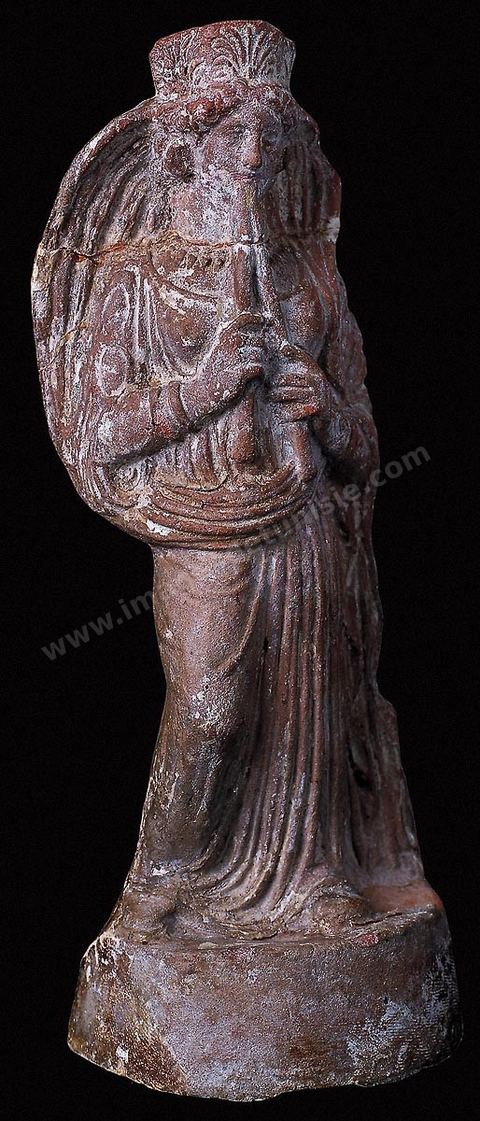
Figurine en terre cuite représentant une femme jouant de la double flûte. Elle porte une tunique longue te un manteau formant voile autour de sa tête, un diadème à palmette et des bijoux (H. 23 cm, nécropole de Borj Jedid, Carthage, IVème siècle avant JC, musée de Carthage).
A02-059
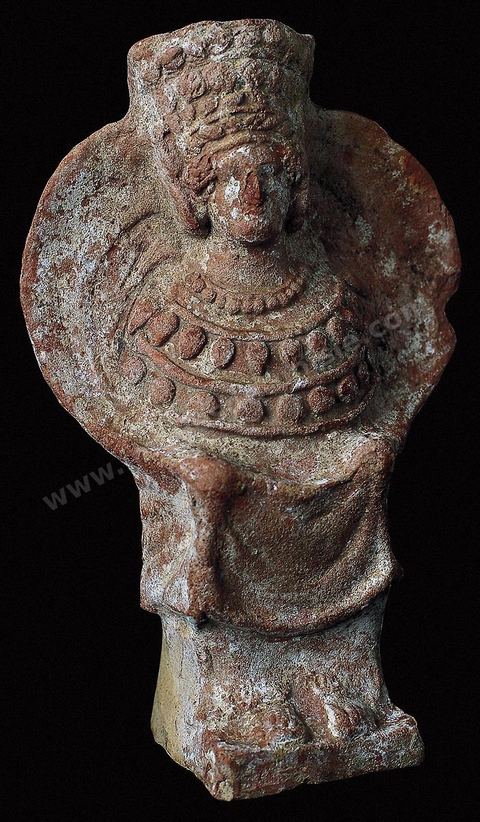
A seated terracotta goddess, her bust surrounded by a circular veil and her head adorned with an enormous diadem. She wears long earrings, and a heavy pectoral made of necklaces covers her chest. This profusion of ornamentation appears to have symbolic significance (H. 18 cm, Punic necropolis of Byrsa, 4th century BCE, Carthage Museum).
A02-060
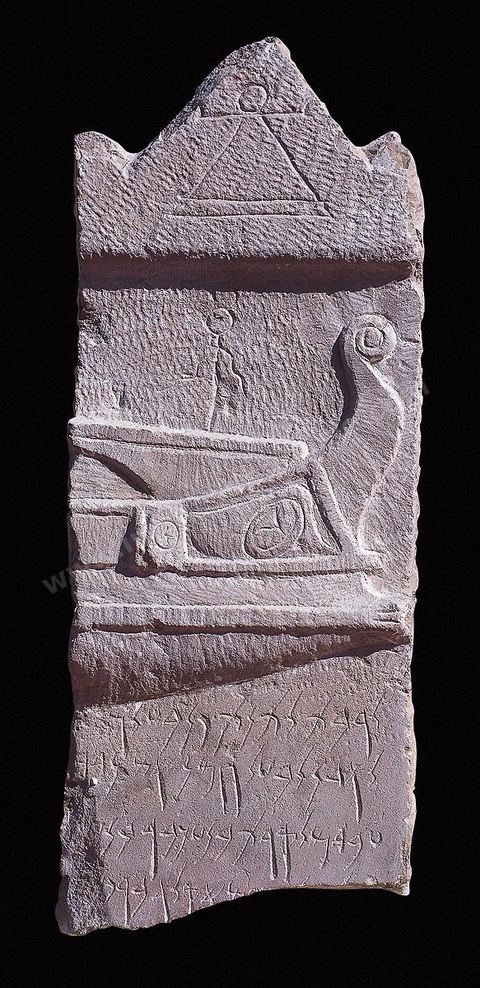
A limestone stele whose pediment is adorned with the so-called sign of Tanit and whose first register depicts a ship similar to the admiral’s galleys on Barcid coins. With its shield on the hull and its trident-shaped stem, it is likely a warship. The second register, which is partially destroyed, contains an invocation to Tanit and Baal Hammon; provenance: Tophet of Carthage; late 3rd century BCE; Punic section; Bardo Museum
A02-061
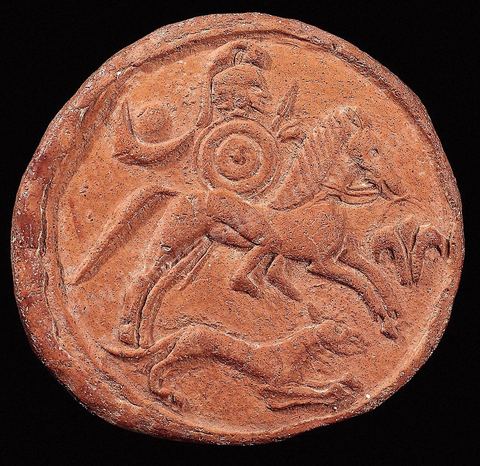
A terracotta medallion depicting a warrior riding bareback on a galloping horse. Wearing a crested helmet and armed with a round shield and a spear, he is accompanied by a dog. To the right of the horse is a lotus or lily flower, and behind the rider are depicted a crescent moon and a sun disk. This may represent a warrior deity (diameter 9 cm, Douimès Necropolis, Carthage, 6th century BCE, Carthage Museum).
A02-062
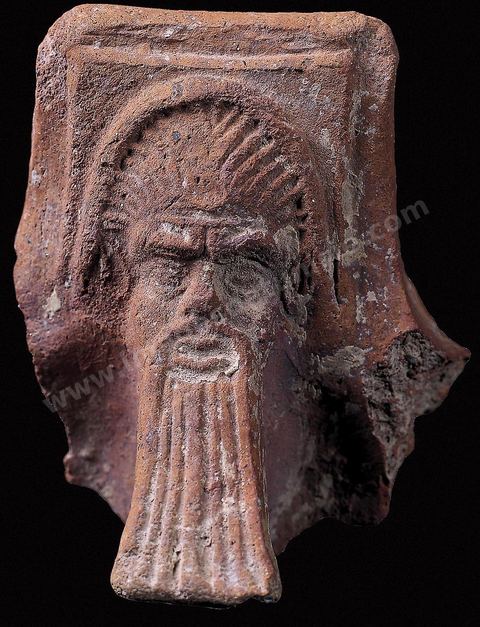
A brazier handle depicting a head adorned with a beard (Carthage Museum).
A02-063
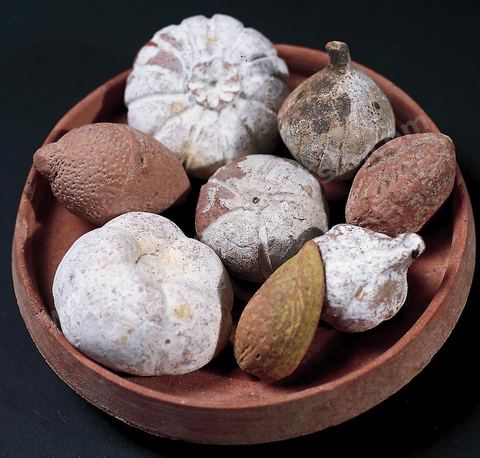
Assiette de fruits en terre cuite (IV-III ème siècle avant JC, musée de Carthage)
A02-064
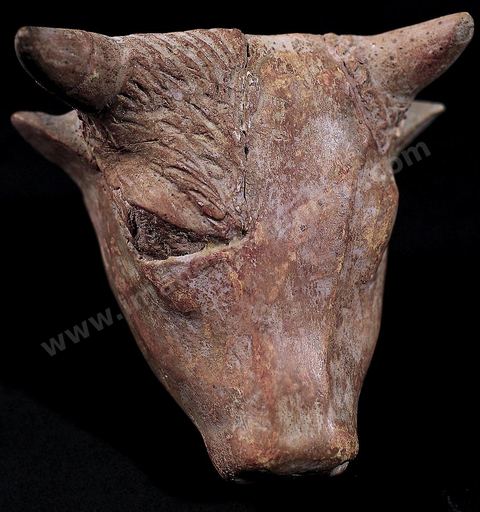
Terracotta cow's head (Carthage Museum)
A02-065
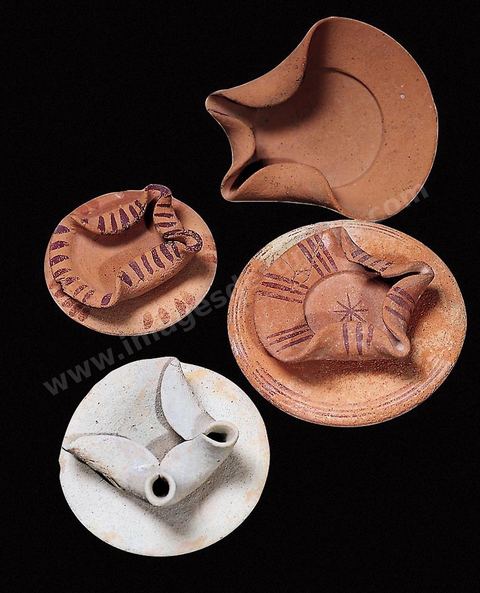
Lampes à huile puniques, leur forme simple est obtenue à partir d'écuelles pincées en deux endroits pour former les becs où l'on disposait les mèches (musée de Carthage)
A02-066
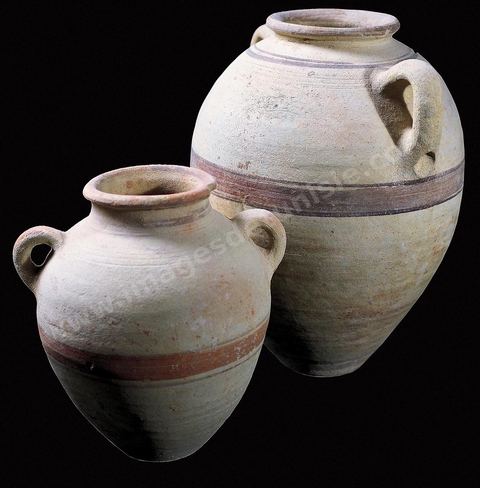
Grandes amphores globulaires à deux anses; argile rougeâtre bien cuite, engobe blanc crémeux sur lequel se détache un décor de lignes horizontales et de bandes rouges; le col est court et large (nécropole punique de Carthage, musée de Carthage).
A02-067
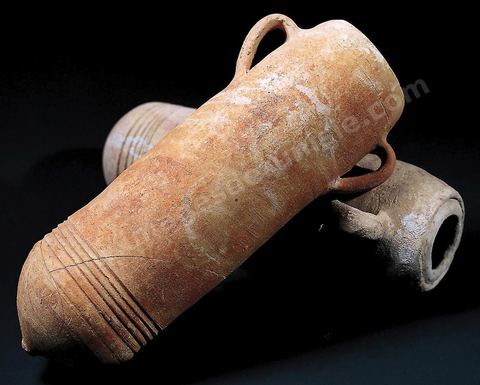
Two cylindrical Punic trade amphorae from the Hellenistic period (4th–2nd centuries B.C., Carthage Museum).
A02-068
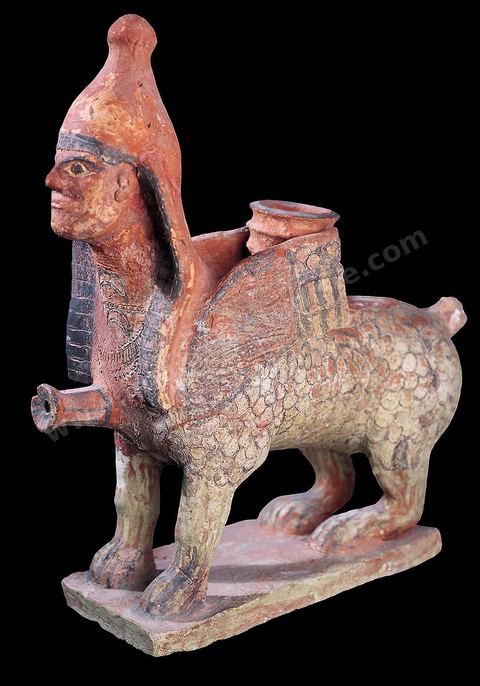
Terracotta vase in the shape of a sphinx. It is topped with a sort of Egyptian pschent in the form of a pointed tiara and has a hole for attaching ornaments. It bears three necklaces around the neck and chest, incised with a drypoint tool before firing (H. 30 cm, W. 32 cm, Archaic Necropolis of Douimès, Carthage, 6th century BCE, Carthage Museum).
A02-069
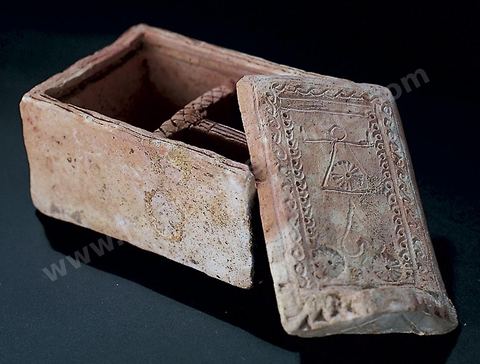
Terracotta jewelry box with a lid decorated with the so-called Tanit symbol and various motifs: rosettes, a heart, and twisted patterns (3rd century, Carthage Museum).
A02-070
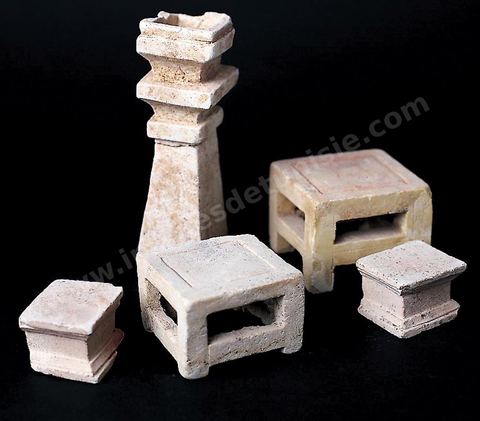
Miniature furniture carved from soft limestone: a table, stools, an altar, and an incense burner, replicating the wooden furnishings of a Punic interior (Douimès and Dermerch necropolises, Carthage, 6th century B.C., Carthage Museum).
A02-072
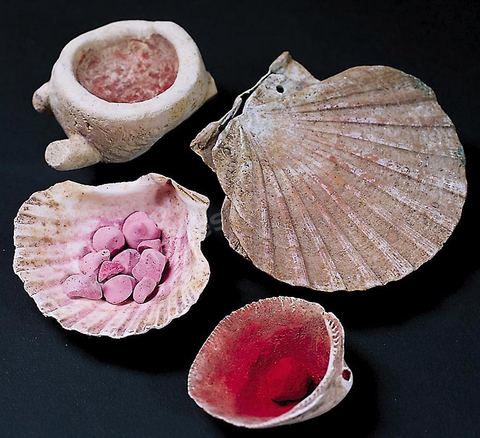
Makeup kit. The Punic woman, ever the coquette, used a wide range of products for her beauty routine: powders (pink and sky blue for blush), ointments, and perfumes (4th–3rd century B.C., Carthage Museum).
A02-073
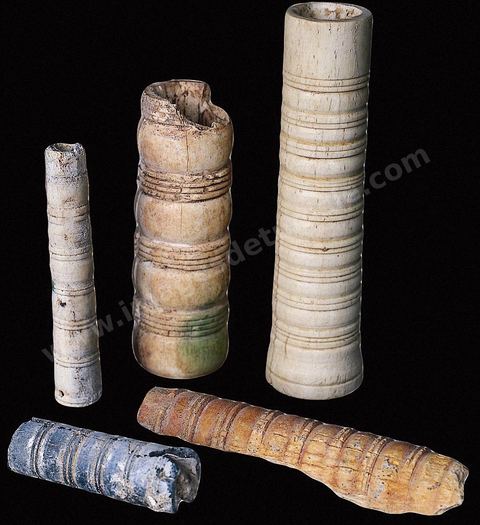
Makeup kit. Punic women, who took great pride in their appearance, used a wide range of products for their beauty routine: powders (pink and sky blue for blush), ointments, perfumes... Kohl case made of glass paste, terracotta, and even seashell, complete with a bone stylus (4th–3rd century BCE, Carthage Museum).
A02-074
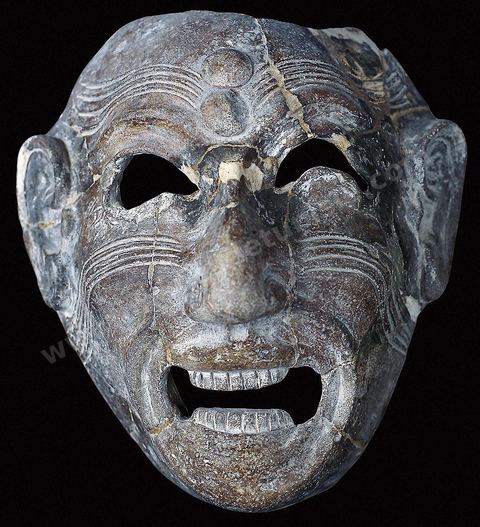
A grotesque, grimacing terracotta mask. This type of mask, inherited from the Phoenicians, was placed in tombs to protect the dead from demons (H. 18 cm, W. 16 cm, Dermech Necropolis, Carthage, late 8th century–early 7th century, Carthage Museum).
A02-075
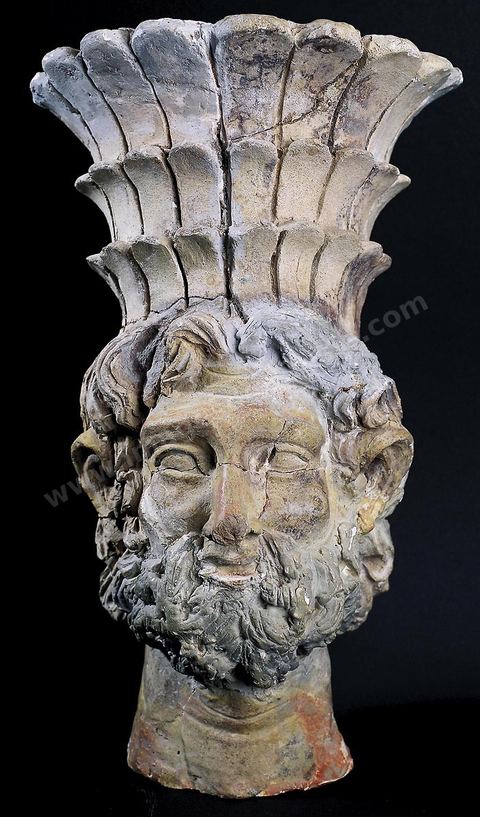
Baal Hammon. A beautiful terracotta head of a male deity, easily recognizable as the great Punic god Baal Hammon. Highly expressive, it still bears traces of vermilion. (H. 30 cm, Sanctuary of Salammbo, Carthage, mid-2nd century B.C., Carthage Museum)
A02-076
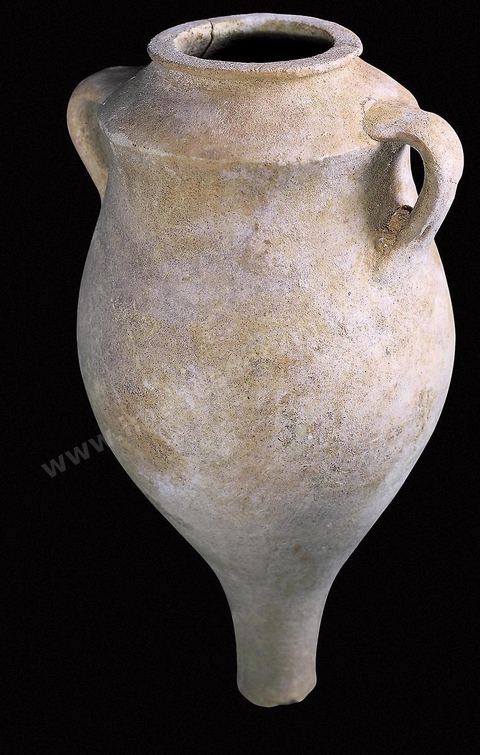
Amphorae known as “empaulement” amphorae, produced in Carthage during the Archaic period and often unearthed at the Tanit I level of the Tophet. Decorated with red bands and black lines (H. 25–30 cm, Tophet, Carthage, 8th–7th century BCE, Carthage Museum).
A02-077
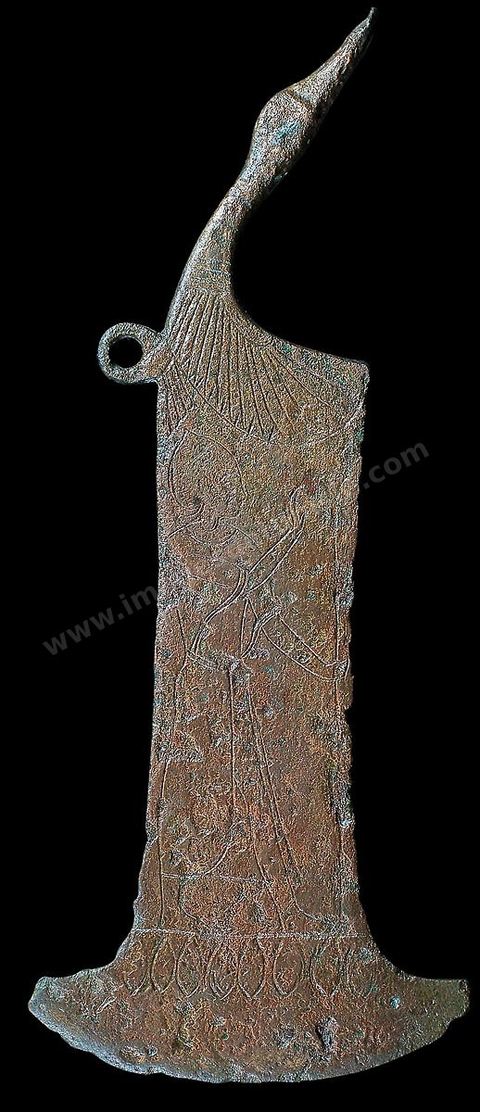
Mirror handle depicting a mother goddess pressing her breasts (H. 13 cm, Douimès Necropolis, Carthage, 7th century B.C., Carthage Museum)
A02-078
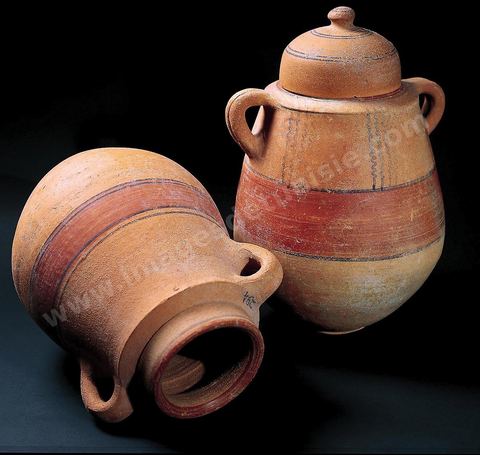
Amphorae known as “empaulement” amphorae, produced in Carthage during the Archaic period and often unearthed at the Tanit I level of the Tophet. Decorated with red bands and black lines (H. 25–30 cm, Tophet, Carthage, 8th–7th century BCE, Carthage Museum).
A02-079
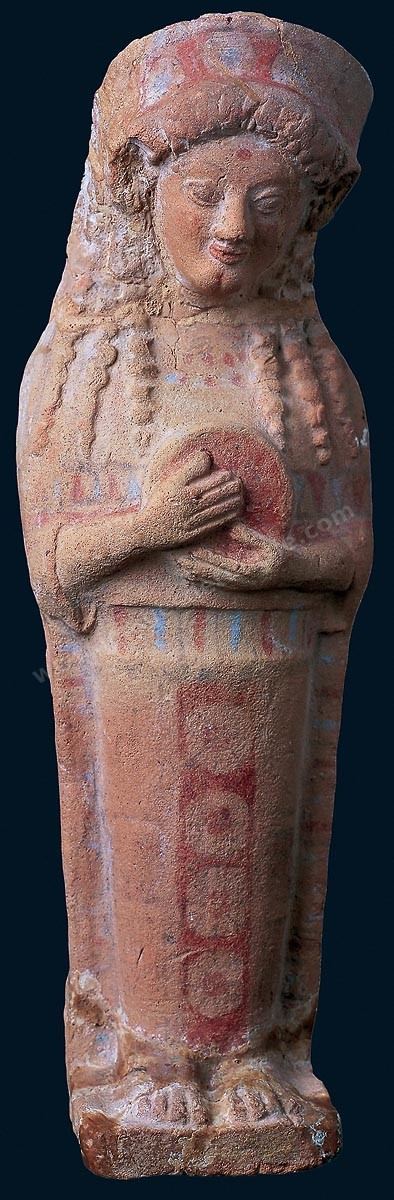
Déesse au tympanon. Cette figurine en terre cuite a l'attitude hiératique egyptienne mais l'ornementation du vêtement et la richesse de ses couleurs sont autant d'emprunts à l'Orient. Le traitement de la chevelure et le diadème qui la coiffe évoquent la Grèce d'Asie (H. 33 cm, nécropole d'Ardh el Morali, fin du VII ème siècle avant JC, musée de Carthage).
A02-080
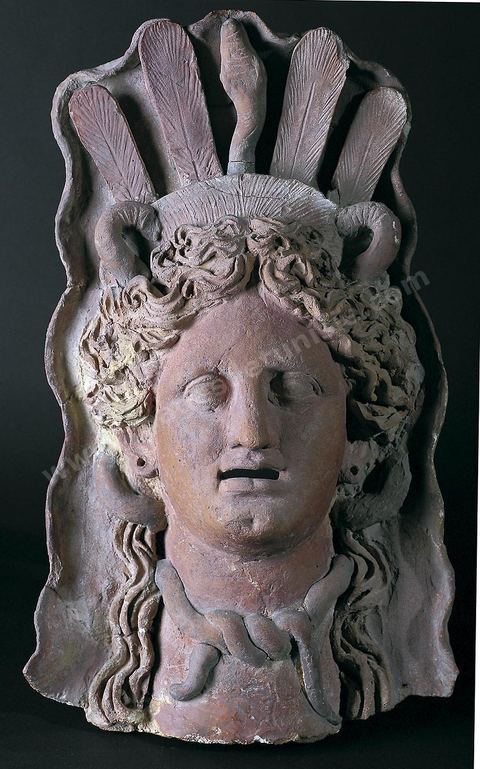
A terracotta mask likely depicting Demeter. The goddess wears a sort of bowl-shaped tiara, framed by a rigid, conch-shaped veil. Vertical, parallel feathers rise from it, with a serpent—a common attribute of chthonic deities—standing out at their center (H. 46 cm, W. 29 cm, Th. 12.5 cm, Salammbô Sanctuary, Carthage, 3rd–2nd century BCE, Carthage Museum).
A02-081
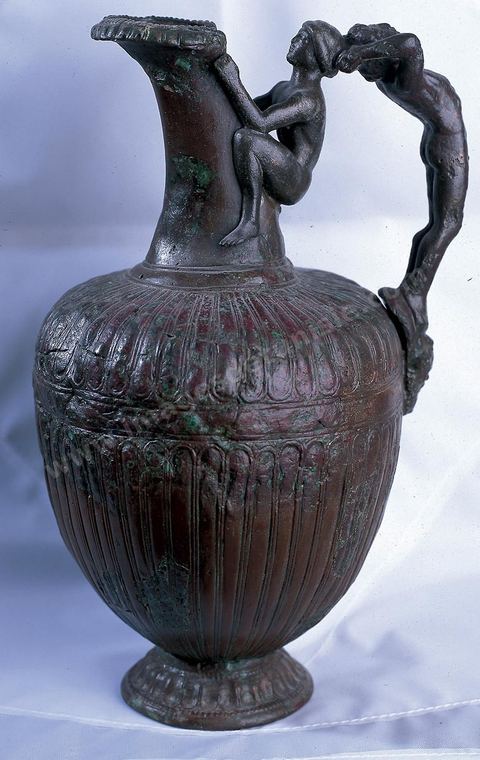
Bronze oenochoe: The body of this bronze oenochoe (wine jug) is adorned with a simple design: fluting on either side of a central band. The handle consists of two figurines: a teenager clinging to the neck of the vessel, which he holds between his legs, and a bearded figure whose body is arched backward, leaning against a mask that serves as the lower attachment, with his hands resting on the teenager’s head. Some scholars attribute this oenochoe to Etruria, others to Tarentum or even Carthage (H. 25 cm, diam. 14 cm, Carthage, 5th century BCE, Carthage Museum).
A02-082
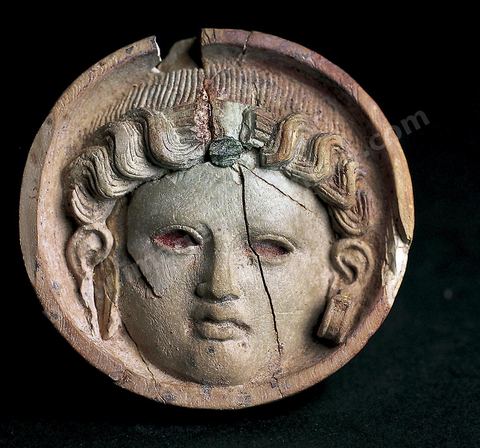
Médaillon en ivoire trouvé dans la nécropole de Sainte Monique (diam. 6,2 cm, musée de Carthage)
A02-083
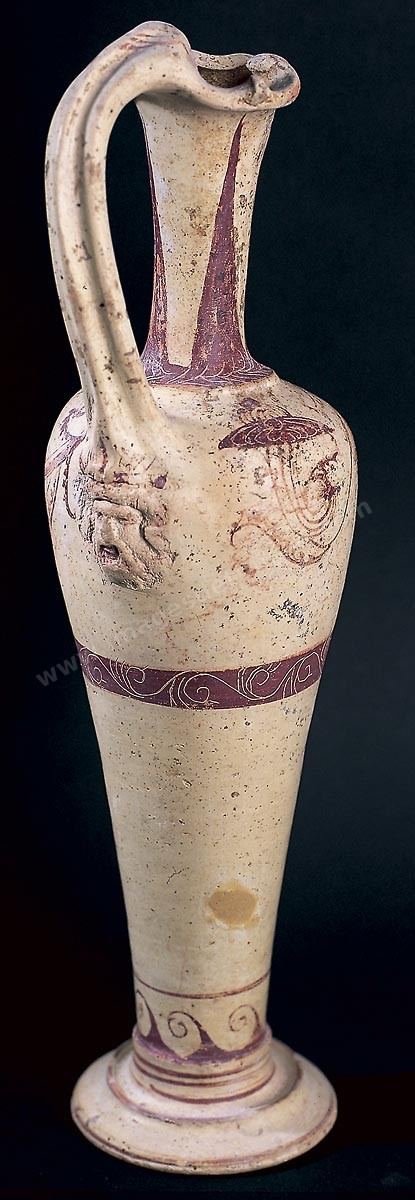
Aiguière en terre cuite ornée d'un décor, dans les tons rouges, varié et d'une grande finesse: en bas de minces filets circulaires et une ligne de flots; au milieu une large bande ornée de rinceaux; autour de la panse, une branchge d'arbuste à feuille s termine par une fleur. Le bas de l'anse repose sur la tête en relief d'un personnage portant une chevelure, une barbe et des moustaches opulentes. (H. 31 cm, nécropole des rabs, Carthage, IV siècle av. JC, musée de Carthage)
A02-084
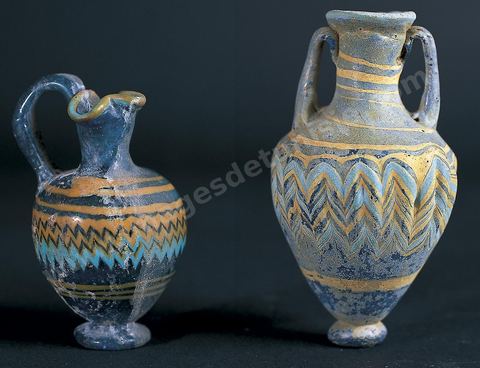
Polychrome glass paste amphorae, inspired by Greek and Hellenistic models. Carthaginian glassmakers began producing them as early as the 7th–5th centuries CE; Carthage Museum.
A02-085
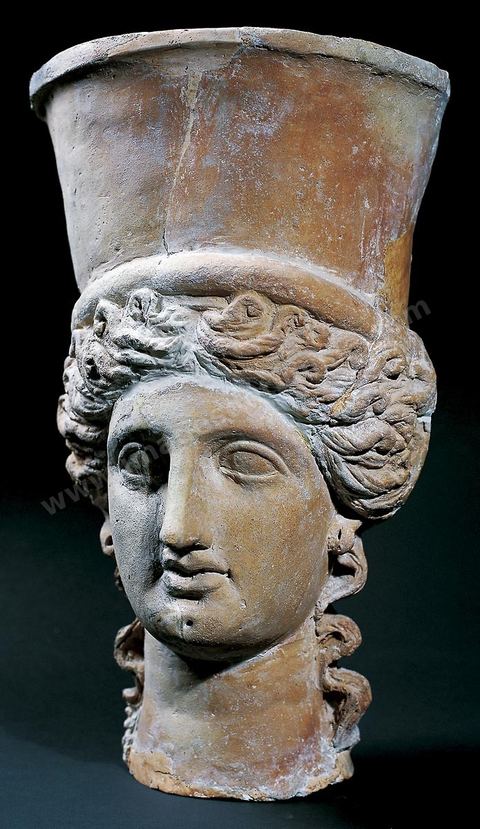
Head of Demeter Kernophoros with regular features, surmounted by a tall, hollow-inside polos (H. 35 cm, Sanctuary of Salammbô, Carthage, mid-2nd century BCE, Carthage Museum).
A02-086
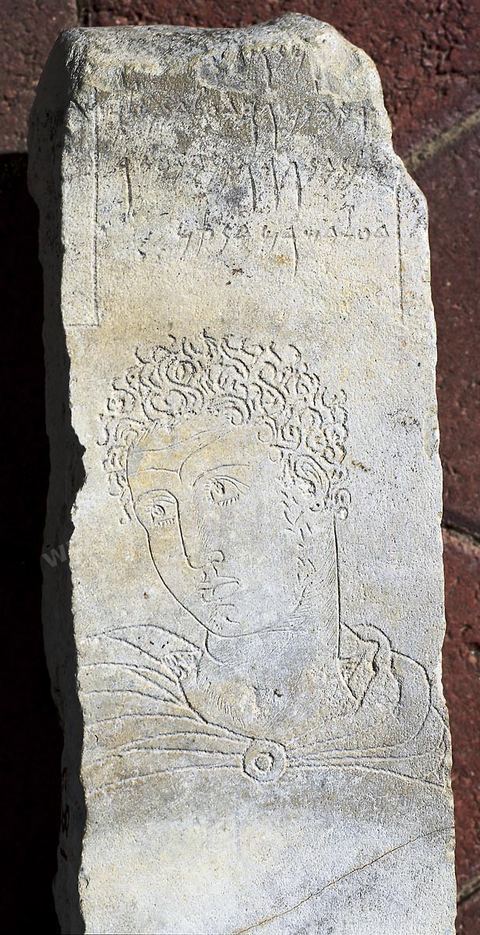
A votive stele made of gray limestone bearing an inscription, beneath which is engraved the face of a teenager clad in a chlamys, whose still, distant gaze seems to be questioning the invisible world. The remarkable intensity of the expression can be compared to Greek or Hellenistic art (H. 75 cm, W. 16 cm, 3rd century BCE, Tophet, Carthage, Carthage Museum)
A02-087
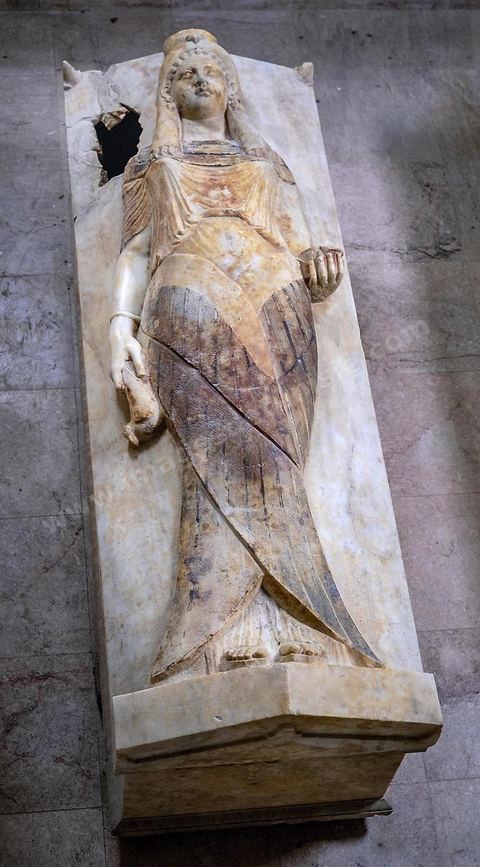
A sarcophagus known as the “Priestess’s Sarcophagus,” made of white marble and decorated with a female figure in high relief. She wears a long pleated robe cinched at the bottom by two large crossed wings. A veil topped with a falcon’s head covers her head in the style of the Klaft. In her right hand she holds a dove, and in her left, an incense burner (H. 93 cm, L. 193 cm, W. 67 cm; Necropolis of Saint Monica, Carthage; 3rd century BCE; Carthage Museum).
A02-088_02 · 2021
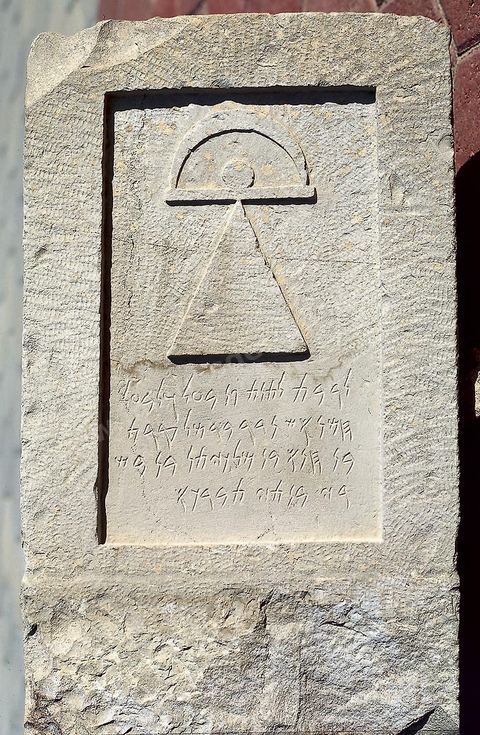
A votive stele made of grayish limestone that stands out from most other steles due to its rectangular shape, its design, the absence of a pediment and acroteria, as well as any other decoration aside from the so-called “Tanit symbol,” which is not incised but carved in bas-relief. While the triangle with a circle resting on its apex is certainly present, the bar above it ends in a semicircle—evoking a crescent—rather than taking on the fairly common anthropomorphic form created by the addition of connected arms. The dedication is in honor of Tanit and her consort, Lord Baal Hammon. This stele confirms the Punic people’s preference for geometric figures and symbolic imagery: the so-called “sign of Tanit” resembles the Egyptian “ankh” and shares its vital significance. Although we possess more than 7,000 stelae (including 1,000 at the Louvre) and more than 6,000 dedications, depictions of Tanit and Baal Hammon in forms other than their symbols are extremely rare (H. 59 cm, W. 33.5 cm, Tophet, Carthage, 4th century BCE, Carthage Museum).
A02-089
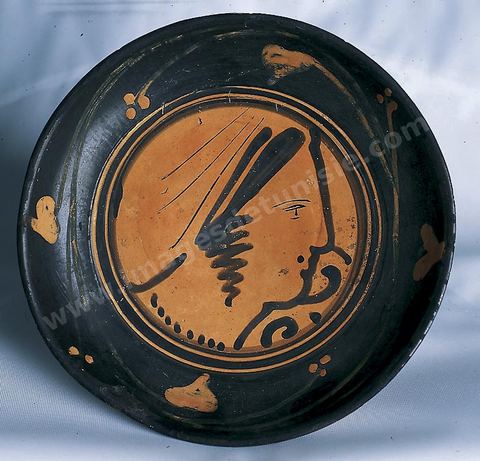
A red-figure plate known as the "Genucilia" plate, believed to originate from Caere (a major Etruscan city), decorated with a female head seen in profile (late Etruscan, 4th century B.C., Carthage Museum).
A02-090
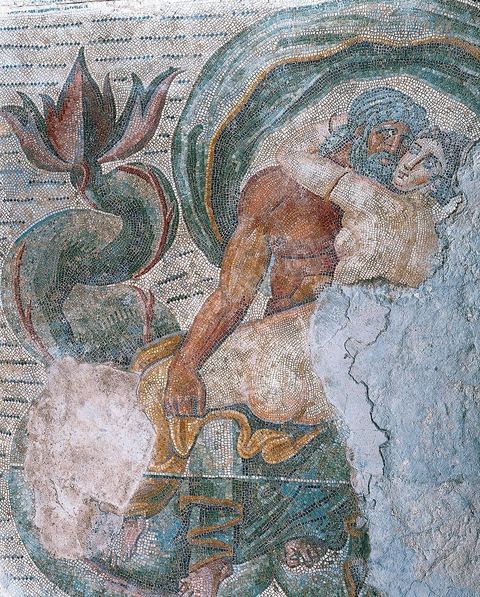
The Wedding of Neptune and Amymone—5th century A.D. Carthage Museum
A02-091
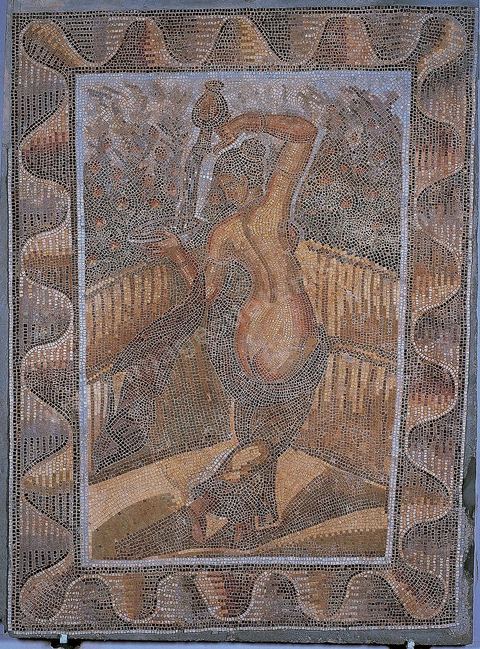
Verseuse d'eau dans une roseraie - V siècle ap. Musée de Carthage
A02-092
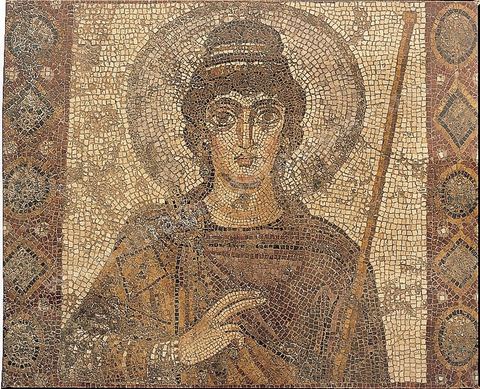
La dame de Carthage - V siècle ap. Musée de Carthage
A02-093
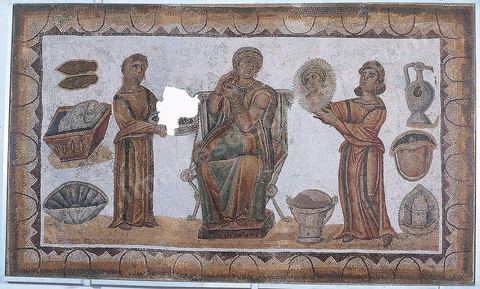
A Lady's Toilette - 5th century A.D. Carthage Museum
A02-094
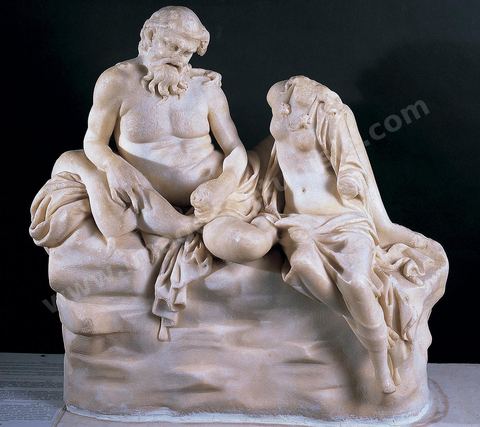
Satyre seduisant une bacchante, groupe statuaire en marbre blanc Musée de Carthage
A02-095
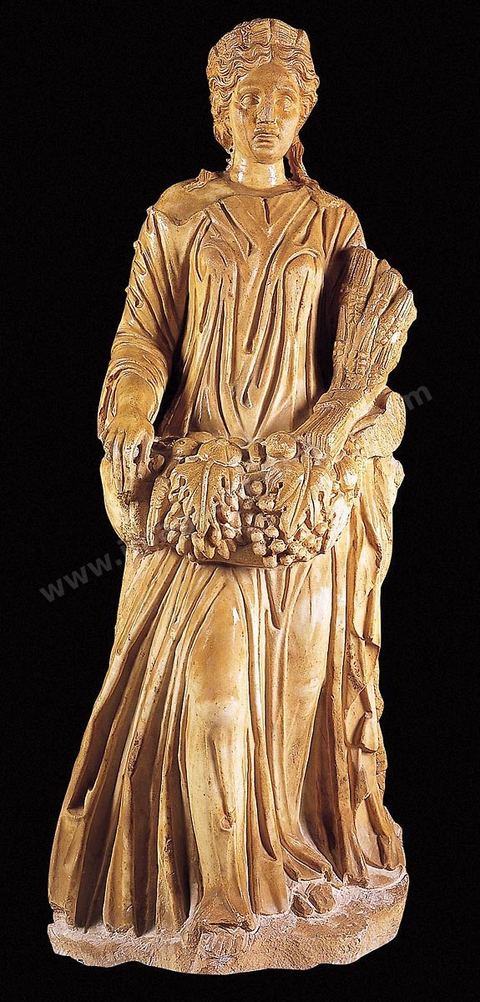
Statue of Ceres, the name given by the Romans to the great Greek goddess of fertility, Demeter, whose cult had been introduced to Africa by the Carthaginians in 396 B.C. Carthage Museum
A02-096
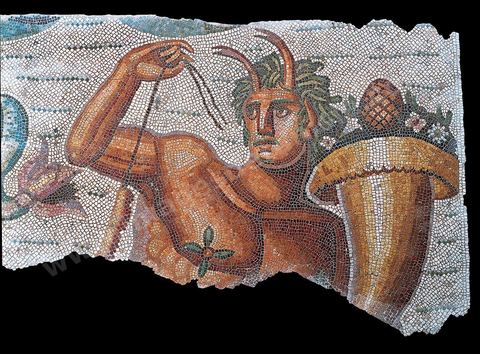
A mosaic fragment depicting a triton, part of a large 5.10-meter-long floor mosaic celebrating the wedding of Neptune and Amymone. Triton is depicted here as a powerfully built figure, wearing crustacean claws on his forehead and holding a cornucopia from which flowers and a pinecone emerge. (Sidi Ghrib; early 5th century, Carthage Museum)
A02-097
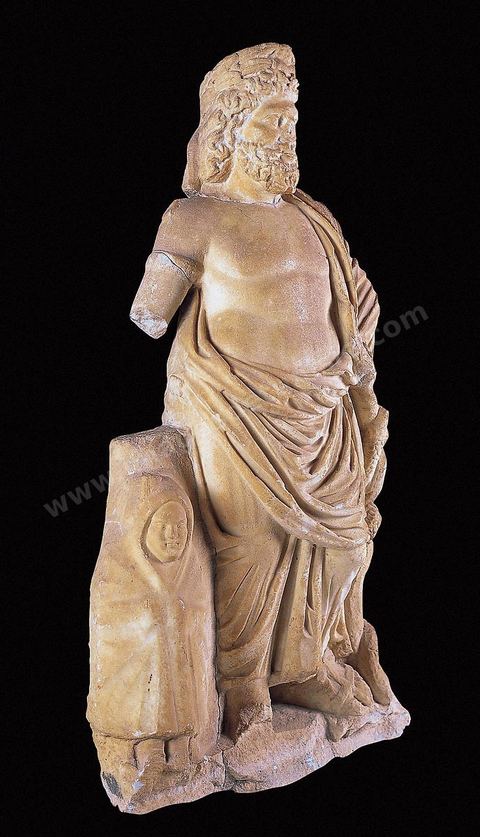
Marble sculpture depicting Aesculapius and Telesphorus. Aesculapius, recognizable by the serpent coiled around a staff, is depicted bare-chested and wearing a modius. Telesphorus, a healing god worshiped alongside Aesculapius, wears a garment with a hood covering his head, Carthage Museum
A02-098
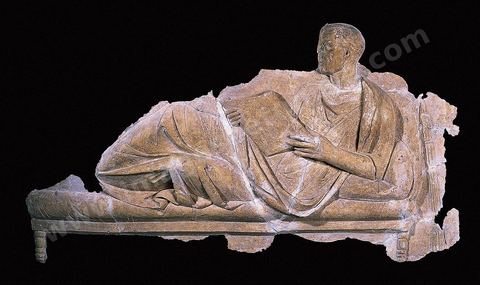
Funeral bas-relief in stucco. The reclining figure is shown reading, a motif frequently used in funerary art that tends to evoke the intellectual qualities of the deceased. Museum of Carthage.
A02-099
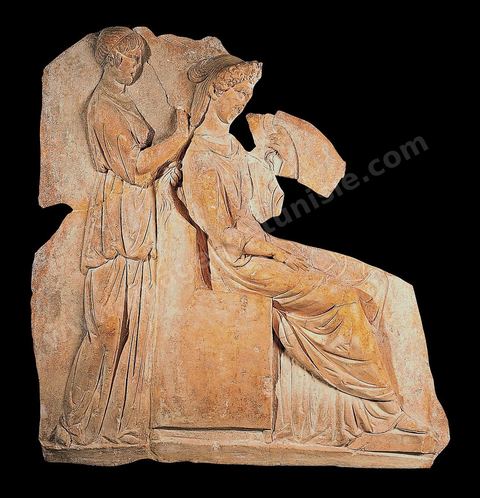
Bas-relief funéraire en stuc figurant une femme en train de se faire coiffer. Cette scène illustre la place importante que la toilette occupait dans la vie quotidienne de la femme, en Afrique, à l'époque romaine. Début du IIème siècle ap JC, Musée de Carthage
A02-100
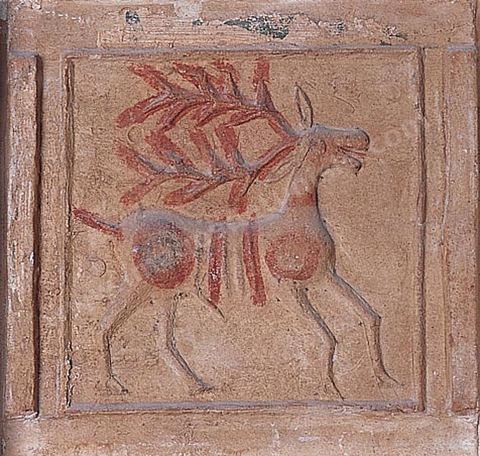
Early Christian terracotta tiles measuring 25 to 28 cm on each side that lined the walls and ceilings of Christian basilicas. Dating primarily from the 6th and 7th centuries, they feature molded or stamped relief patterns that have been painted: biblical themes and symbolic animals (deer, lions, griffins, etc.). Carthage Museum.
A02-101
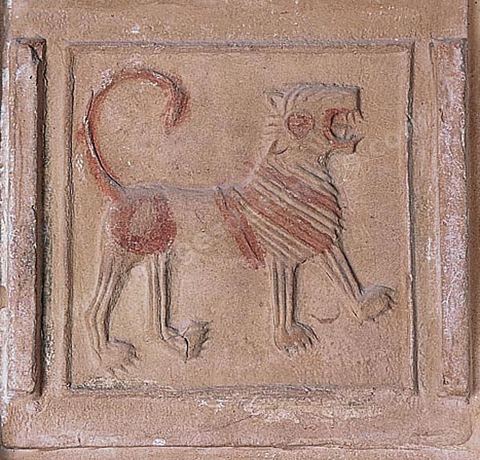
Early Christian terracotta tiles measuring 25 to 28 cm on each side that lined the walls and ceilings of Christian basilicas. Dating primarily from the 6th and 7th centuries, they feature molded or stamped relief patterns that have been painted: biblical themes and symbolic animals (deer, lions, griffins, etc.). Carthage Museum.
A02-102
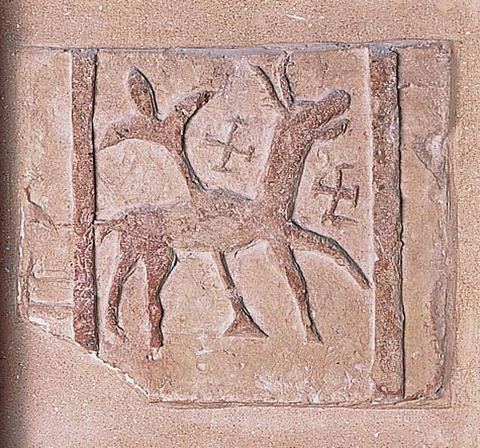
Early Christian terracotta tiles measuring 25 to 28 cm on each side that lined the walls and ceilings of Christian basilicas. Dating primarily from the 6th and 7th centuries, they feature molded or stamped relief patterns that have been painted: biblical themes and symbolic animals (deer, lions, griffins, etc.). Carthage Museum.
A02-103
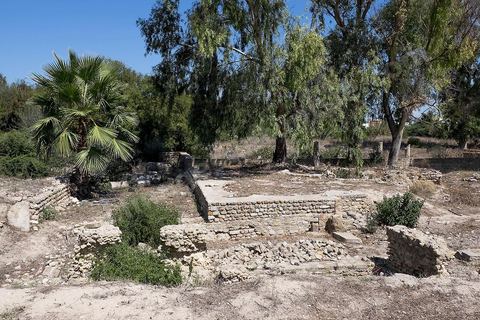
Site du musée paléochrétien de Carthage
A02-104 · 2015
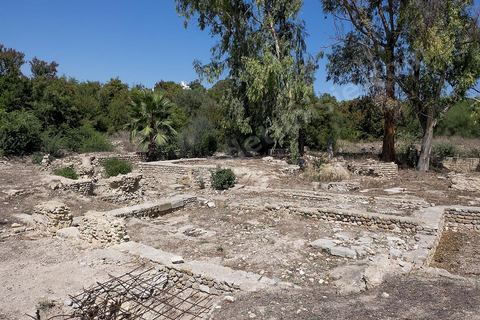
Site du musée paléochrétien de Carthage
A02-105 · 2015
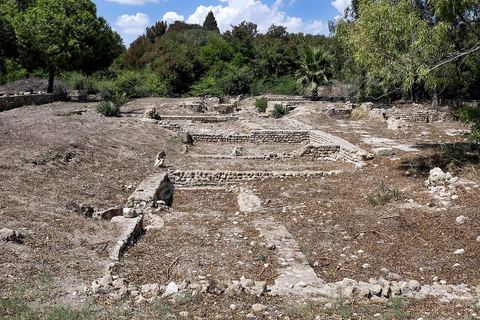
Site du musée paléochrétien de Carthage
A02-106 · 2015
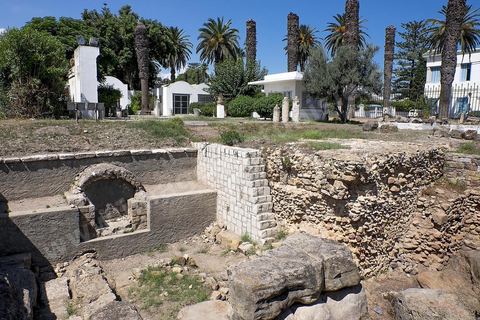
Site punique du quartier Magon
A02-107 · 2015
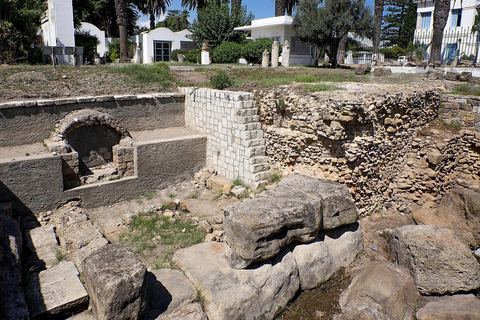
Site punique du quartier Magon
A02-108 · 2015